
Loading Experience
Loading Experience
What the research from developers, banks, consultancies and governments says about 2027: where prices are heading, how construction is recovering, what governments are doing about supply, how buyers are changing and why the sale itself is moving online. And what it means for anyone launching a project next year.
A year of moderate growth and fewer, more demanding launches. Prices are expected to rise slowly, construction to recover after a weak 2026, governments from Europe to Latin America to keep pushing for supply they're struggling to deliver, the US to move slowly under high mortgage rates, and buyers to arrive older, more international and almost always online first. The projects that sell will be the ones that can be understood, trusted and bought from a screen.
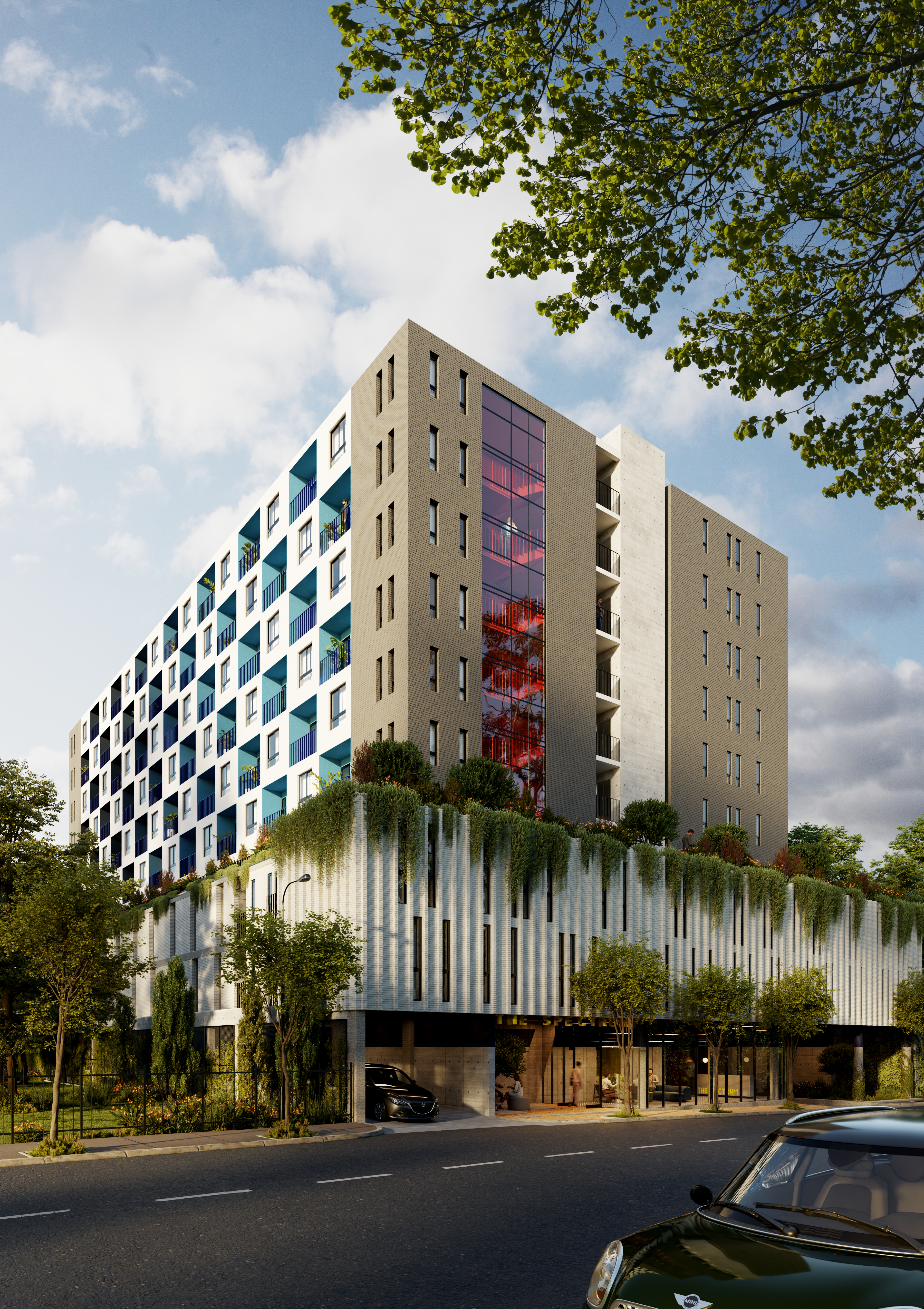
Exterior render of a residential development, by 77 Render Studio
Up, but gently, and very unevenly. Forecasts point to low single-digit growth in most prime markets, with Asia leading, some European cities strong and China still adjusting.
Knight Frank expects prime prices across 20 global cities to rise 2.2% on average in 2027, up from 1.6% in 2026. (Knight Frank, Global Residential Signals, July 2026)
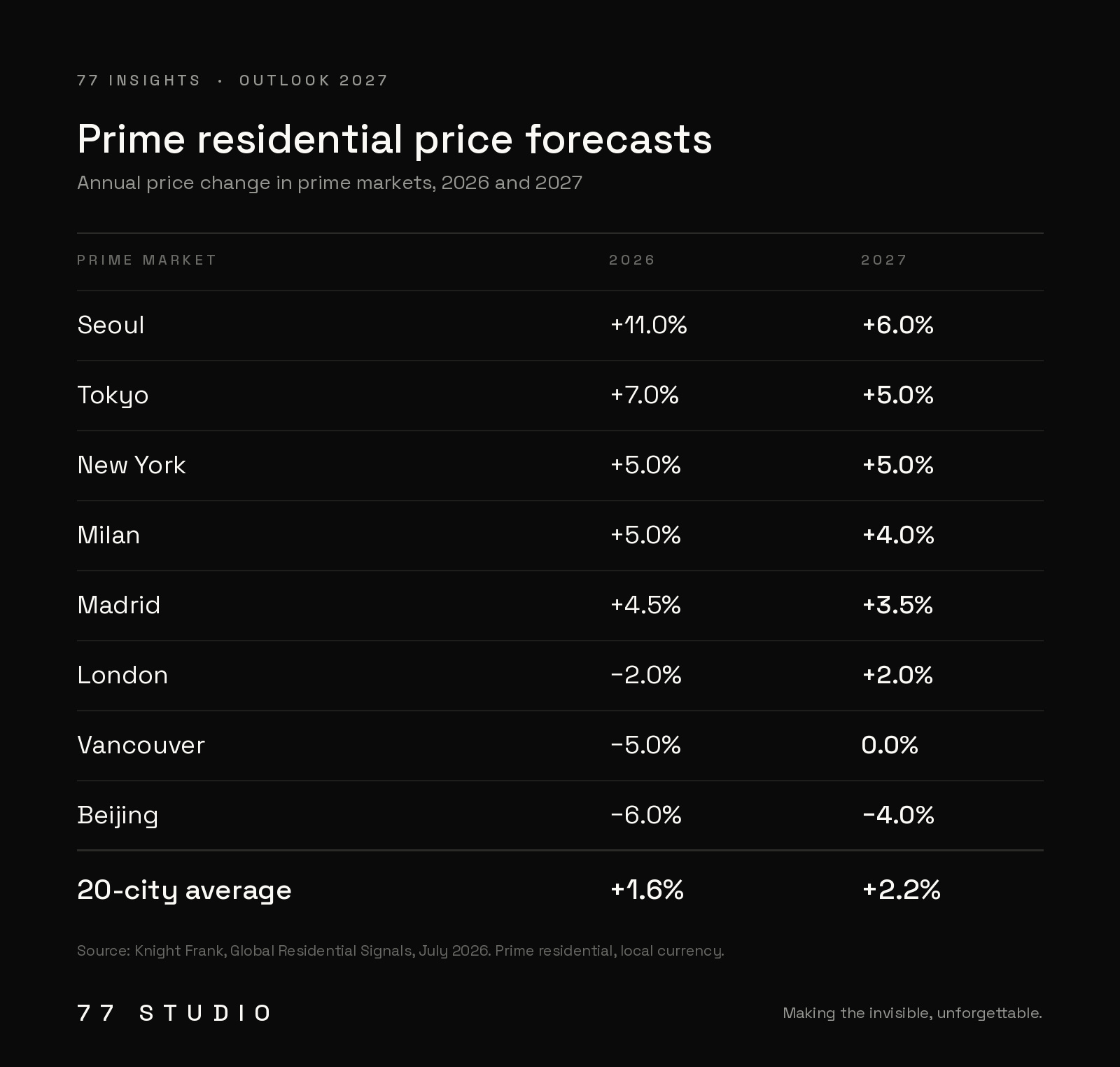
Prime residential price forecasts 2026–2027 by city: Seoul +6%, Tokyo +5%, New York +5%, Milan +4%, Madrid +3.5%, London +2%, Vancouver 0%, Beijing −4%. 20-city average +2.2% in 2027. Source: Knight Frank
UBS reaches a similar conclusion from another angle. Across the 23 cities in its 2026 Bubble Index, real house prices were broadly flat over the past year, and owning a home costs more than 40% of a highly skilled worker's gross income in most of them. "Higher-for-longer financing costs are likely to cap house-price gains in the near term," says lead author Matthias Holzhey. (UBS Global Real Estate Bubble Index 2026, September 2026)
One signal stands out for anyone selling across borders: Knight Frank found that no city in its forecast expects international buyer interest to fall.
A recovery after a weak year, under pressure from costs. Global residential construction is expected to grow faster in 2027 than in 2026, but energy, materials, labour and interest rates will keep pipelines tight.
Credit insurer Atradius expects global construction output to grow 1.4% in 2026, with residential construction at just 0.8%, rising to 3.0% in 2027. The rebound is broad: US residential construction +3.4%, China's total construction +4.4% and Germany +5% a year in 2027 and 2028, after two years of contraction. The pressures are the same everywhere: energy prices pushed up by the conflict in the Gulf, materials costs, labour shortages and high interest rates. (Atradius, Industry trends: construction, August 2026)
For developers, fewer projects reaching the market means less competition for some, and less margin for error for all. Each launch has to perform.
Setting ambitious targets and struggling to meet them. Across markets, governments are trying to unlock supply through planning reform, financing support and digital processes, but delivery is running behind.
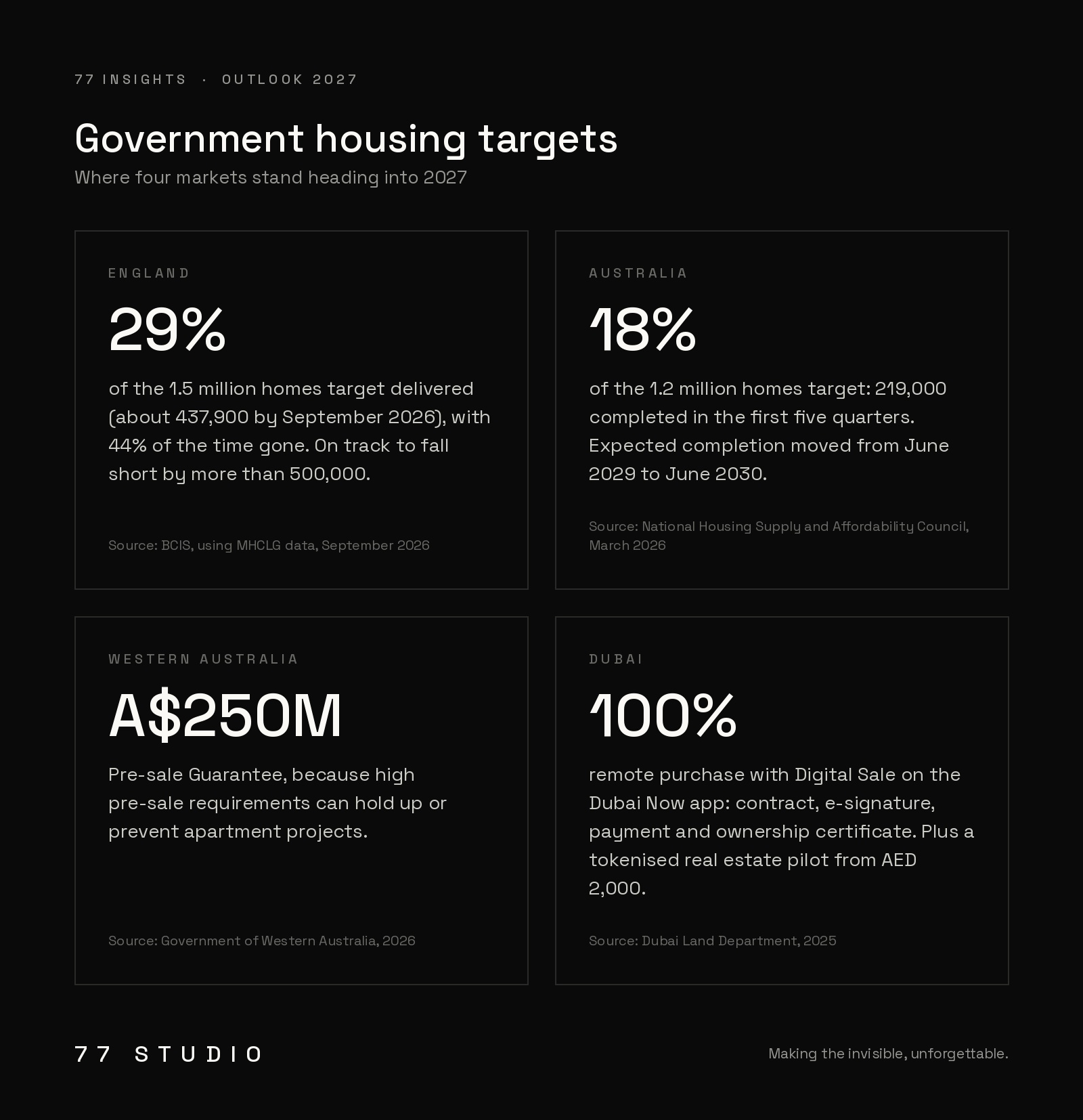
Government housing targets heading into 2027: England has delivered 29% of its 1.5 million homes target, Australia 18% of 1.2 million, Western Australia offers an A$250M pre-sale guarantee and Dubai enables 100% digital property purchase
The common thread: governments are no longer only regulating how homes are built, but also how they are financed and sold.
A slow market with a structural shortage underneath. Higher mortgage rates are expected to keep sales and price growth low in 2027, while the country still lacks millions of homes.
Fannie Mae now expects 30-year mortgage rates to average 7.5% throughout 2027, total home sales of 4.71 million and home price growth of just 0.6%, after raising its rate forecast in October. (Fannie Mae Economic and Strategic Research, October 2026, reported by Florida Realtors) At the same time, Realtor estimates the US housing supply gap at 4.03 million homes. ( Realtor.com, 2026 Housing Supply Gap Report, March 2026)
The prime market is moving differently: Knight Frank still forecasts +5% for prime New York in 2027. In a slow market, buyers become more selective, and projects have to work harder to be chosen.
Governments are the main engine of housing construction, while private markets adjust to high rates. The need is enormous, and so is the pipeline of public programmes.
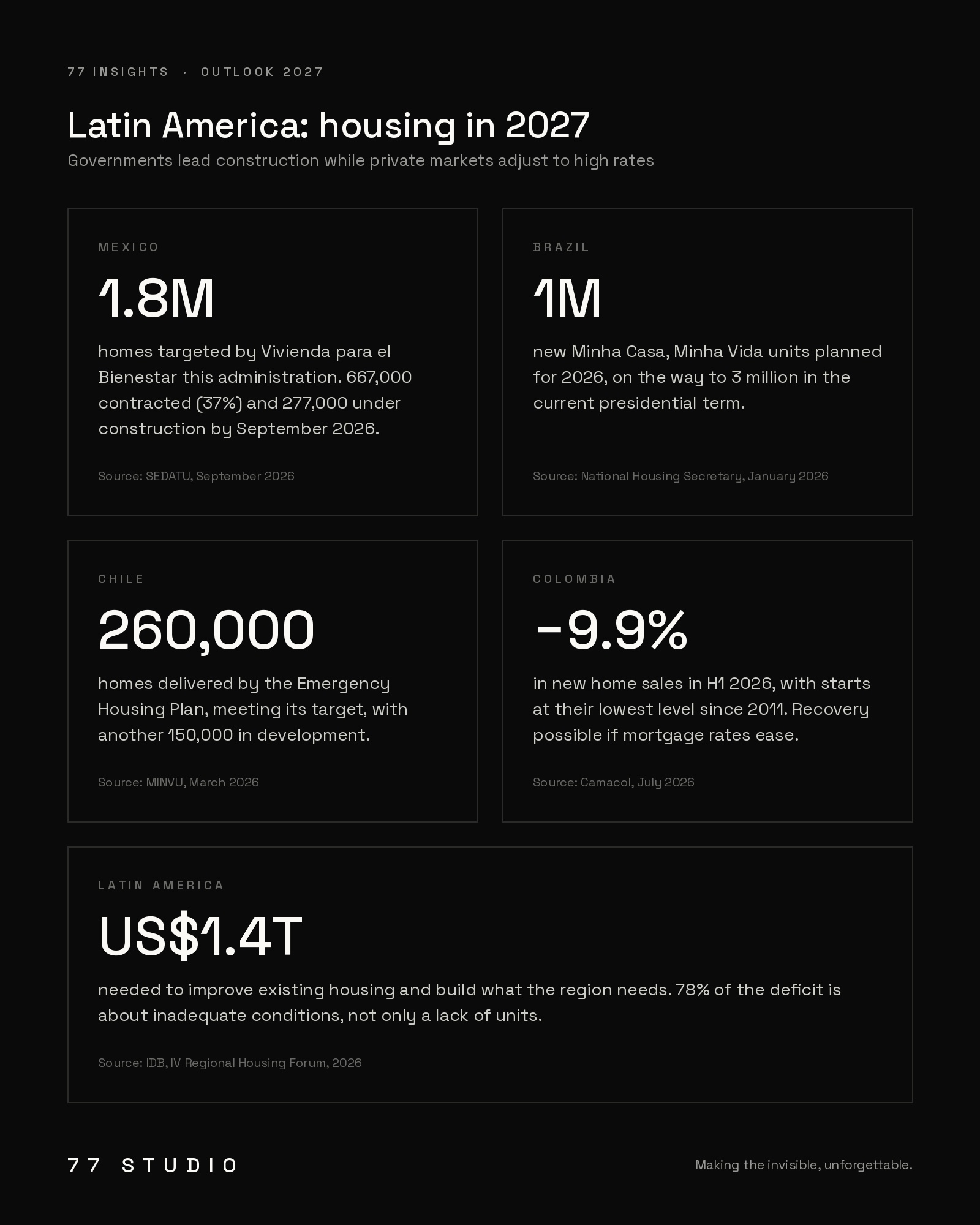
Latin America housing outlook 2027: Mexico targets 1.8 million homes, Brazil 1 million units in 2026, Chile delivered 260,000 homes, Colombia new home sales down 9.9%, and the region needs US$1.4 trillion according to the IDB
The Inter-American Development Bank estimates that improving existing housing and building what the region needs would require about US$1.4 trillion, and that 78% of the deficit is about inadequate conditions, not only a lack of units. (IDB, IV Regional Housing Forum, 2026) For private developers, that means a market with real demand, strong public support at the affordable end and buyers who compare more than ever before committing.
The largest players keep launching while the market as a whole slows down. Scale, brand and track record are concentrating demand.
In Dubai, new launches fell to 28,000 units across 124 projects in the first half of 2026, from 102,000 units across 410 a year earlier, as some developers deferred projects. (Cavendish Maxwell, H1 2026, reported by TradeArabia) In the same period, Emaar booked AED 26.6 billion in property sales, launched 11 projects, grew its backlog 13% to AED 164.9 billion and announced a new AED 200 billion masterplan. (Gulf News, Emaar H1 2026 results, August 2026)
Brand is part of that concentration. Knight Frank counts 903 branded residence schemes worldwide at the end of 2025, nearly triple the 354 of 2015, and expects about 1,088 by the end of 2026 and close to 1,800 by 2031. (Knight Frank, The Residence Report 2026, September 2026) Projects without a famous name still have to compete with them for attention.
They start online, they are older, more of them buy from abroad, and they expect to explore a home, not just look at it.
In the US, 52% of buyers found the home they bought online and for 46% the first step was searching the internet. (NAR, 2025 Profile of Home Buyers and Sellers) First-time buyers fell to a record-low 21% of the market, with a record-high median age of 40. (NAR, November 2025) Foreign buyers purchased $45.3 billion of US homes in a year, and 44% of them lived abroad. (NAR, 2026 International Transactions in U.S. Residential Real Estate) And 70% of buyers say 3D tours give a better feel for a space than photos, while 65% wish more listings had them. (Zillow, Consumer Housing Trends Report 2025)
These figures are from the US, the most studied market, but the pattern repeats wherever developers sell to second-home buyers, investors and relocating families. PwC and ULI add that millennials are entering their prime buying years: the most digital generation of buyers is becoming the largest.
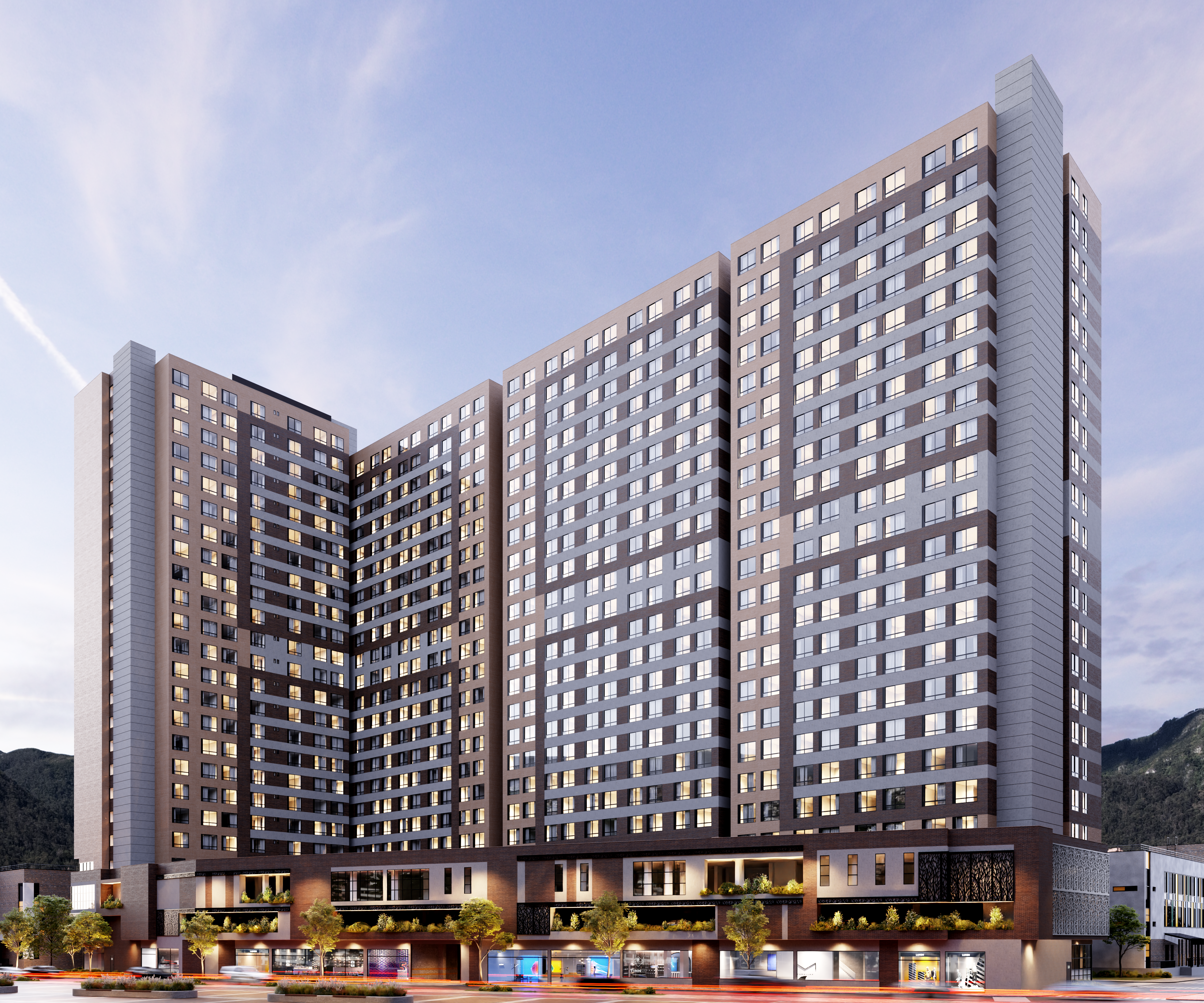
Render of a residential project’s exterior, by 77 Render Studio
The first visit to a project already happens on a screen. In 2027, buyers will expect it to feel like the real thing: immersive, explorable and organised around the home they could buy.
For new developments, where there's nothing to visit yet, that expectation lands on the digital showroom: the place, every typology, real views, live availability and a clear next step, in one place.
Where 77 fits
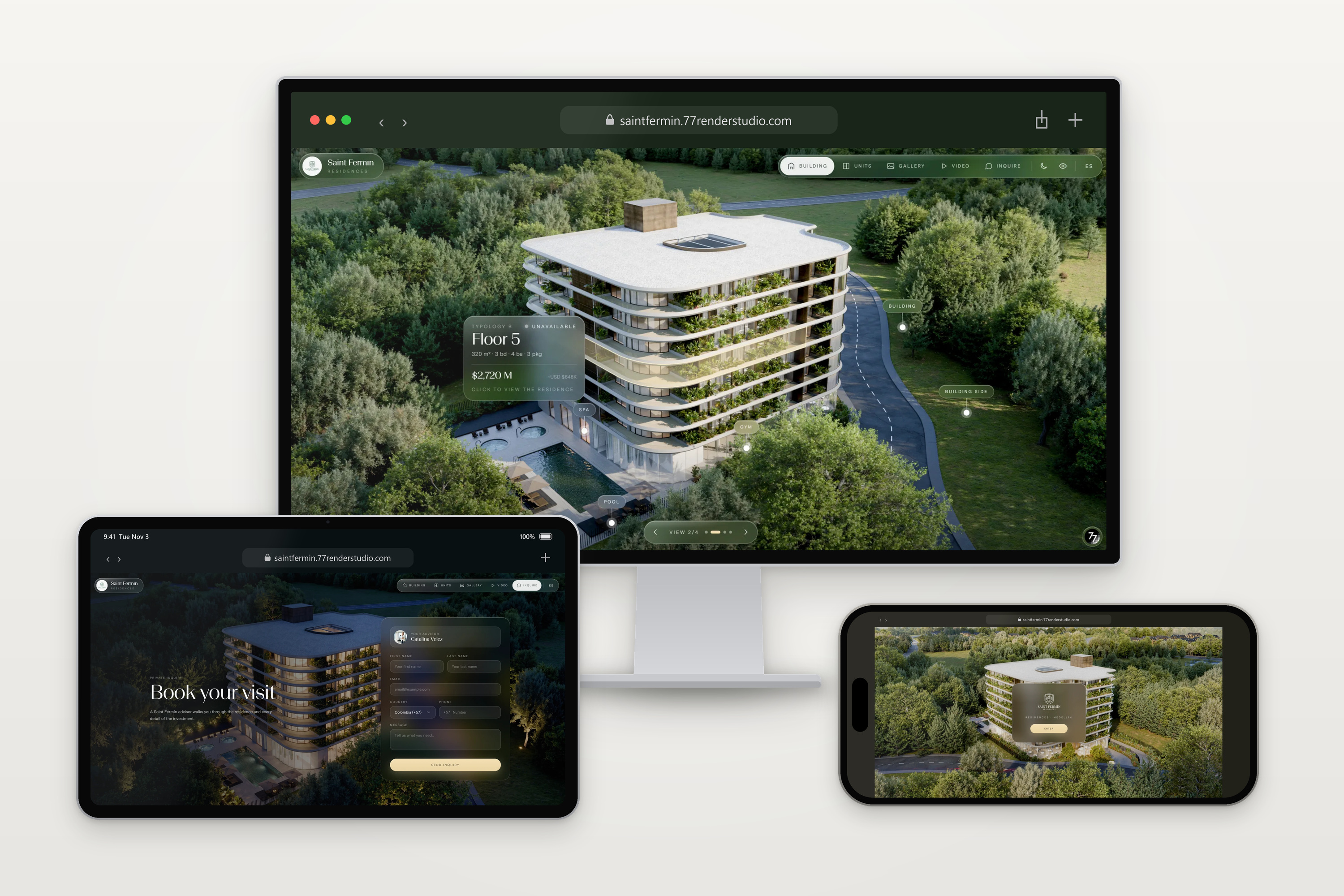
We build digital showrooms where buyers explore the project, every typology and live availability, and take the next step without leaving. We explain the model in What Is a Digital Sales Showroom, and you can see one live at Saint Fermín Residences.
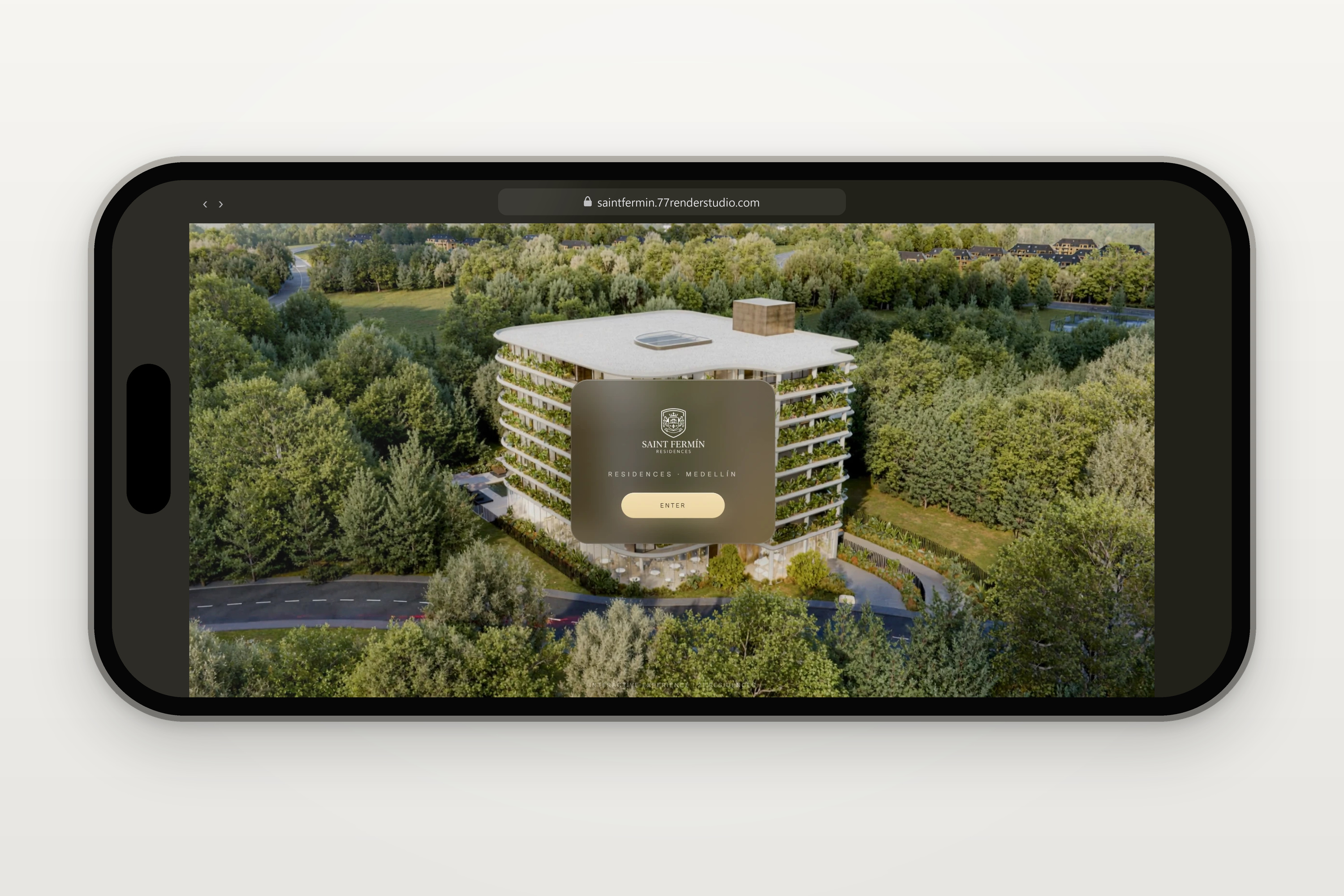
Digital showroom of a real estate project viewed on a mobile phone, by 77 Render Studio
Contracts, signatures, payments and even ownership are moving online. Where the rules allow it, a buyer can go from wanting a home to owning it without a single meeting.
Dubai's Digital Sale service already works that way for eligible properties. (Dubai Land Department, October 2025) New developments are moving in the same direction: at The Marlow on Mill in Cape Town, the project's sales team reported 68 apartments sold within 10 minutes of launch, through a fully digital purchase process. (Pam Golding Properties, sales agency for the developer, September 2025)
Where 77 fits
When the purchase can happen online, the visuals have to do the work of the site visit: explain the project, show every unit and give the buyer enough confidence to commit from another city or another country. That is the work we do at 77.
In Cape Town, we created the visuals for The Marlow on Mill, where 68 apartments were sold within 10 minutes of launch through a fully digital purchase process. In the Austrian Alps, we have worked as a partner to Park Seefeld since 2021, from concept to sales, and we continue to support the project as it prepares its next phases. In Berlin, Havelufer Quartier was presented with a 360° tour for each typology, so buyers could walk through the exact type of unit they were considering.
Different markets, one constant: buyers who decide at a distance need to see, understand and trust a project before it exists.

Render of a residential pool area, by 77 Render Studio
Real estate firms are spending more on technology, and AI is starting to run in real workflows. The advantage in 2027 will come from using it where it changes results.
In Deloitte's 2027 outlook, more than 90% of real estate executives plan to increase data and technology spending, up from 76% a year earlier, and almost half of organisations already run agentic AI in some live workflows, though 92% are still piloting or researching. (Deloitte, 2027 Commercial Real Estate Outlook, survey of 950 executives, September 2026) As PwC and ULI put it: "Advantage will come from strategic deployment and measurable results, not adoption alone."
Where 77 fits
Our digital showrooms come with an analytics dashboard that shows which units buyers explore, where they come from and which channels bring them, and connects to the developer’s own CRM. AI agents can work inside the showroom, answering and qualifying enquiries at any hour, so every lead reaches the sales team with the units the buyer explored. That is how AI should be measured: by what it does for the pipeline.
Plan for a slower, more selective market and a buyer who decides online. Before launching, check that the project can be understood, trusted and bought from a screen.
Can a buyer in another country explore every typology, its views and its plan?
Is live availability visible, and is the next step one click away?
Does every enquiry reach the sales team with what the buyer already explored?
Is there content for every phase, so the project keeps selling through construction?
Does the project have a brand, not just a name?
Is the visual language the same from the first render to handover?
Because these shifts don’t arrive one at a time, and solving them with five different vendors creates five different versions of the same project. At 77, the renders, the films, the digital showroom and the brand are built by one team, with one visual language and one goal: that buyers understand the project, trust it and choose it. The developer gets a single partner and a single, consistent story, from the first image a buyer sees to the moment they sign.
Sources
Knight Frank, Global Residential Signals (July 2026)
Knight Frank, The Residence Report 2026 (September 2026)
UBS, Global Real Estate Bubble Index 2026 (September 2026)
Atradius, Construction Industry Trends (August 2026)
JLL, Global Real Estate Outlook, mid-year update (August 2026)
PwC and Urban Land Institute, Emerging Trends in Real Estate 2027 (October 2026)
Deloitte, 2027 Commercial Real Estate Outlook (September 2026)
BCIS, using MHCLG data (September 2026)
National Housing Supply and Affordability Council, Australia (March 2026)
Government of Western Australia, Pre-sale Guarantee (2026)
Dubai Land Department, Digital Sale (October 2025)
Khaleej Times, Prypco Mint (May 2025)
Cavendish Maxwell, Dubai H1 2026 (July 2026)
Gulf News, Emaar H1 2026 results (August 2026)
Fannie Mae, Housing Forecast (October 2026)
Housing Supply Gap Report (March 2026)
SEDATU, Mexico (September 2026)
National Housing Secretary, Brazil (January 2026)
MINVU, Chile (March 2026)
Camacol, Colombia (July 2026)
Inter-American Development Bank, IV Regional Housing Forum (2026)
NAR, Profile of Home Buyers and Sellers and International Transactions (2025–2026)
Zillow, Consumer Housing Trends Report 2025
Pam Golding Properties, The Marlow on Mill (September 2025)
Let's talk about how visualization and a digital showroom can shorten your sales cycle.