The context
For established architecture studios, competitions are both the most prestigious way to win a project and one of the most expensive. Today's international competitions usually start with an open call or a pre-qualification, then narrow to a shortlist of teams that develop a full proposal for a jury.
The investment behind each proposal keeps growing. Architectural Record reported in 2025 that competition stipends "rarely cover more than one-fifth of the actual costs" for the firms involved, and that per-team spending can easily reach the hundreds of thousands of dollars. Deliverables now commonly include drawings, models, renderings, videos and technical studies. (Architectural Record, June 2025)
Paris remains one of the most competitive stages for this work. In May 2026, the Louvre announced the winner of its international competition for the Grande Colonnade, chosen among five shortlisted consortiums of architecture studios. (Musée du Louvre, 2026)
The challenge
A jury doesn't walk through a project, and in many competitions it doesn't even know who designed it, because anonymity is one of the core principles of a fair process. It reads each entry from boards and screens. The ideas that took the design team weeks to develop (how a space opens up, how light enters, how people will use it) have to be understood in seconds and compared side by side with other entries.
The profession's own guidance puts it clearly: "The depth of elaboration must allow the jury to recognise a concept's quality and to make an objectifiable decision." (ARCH-E White Paper, 2025) That is the job of competition visualization: not to decorate a proposal, but to make the quality of its ideas impossible to miss.
Featured: an office renovation in Paris
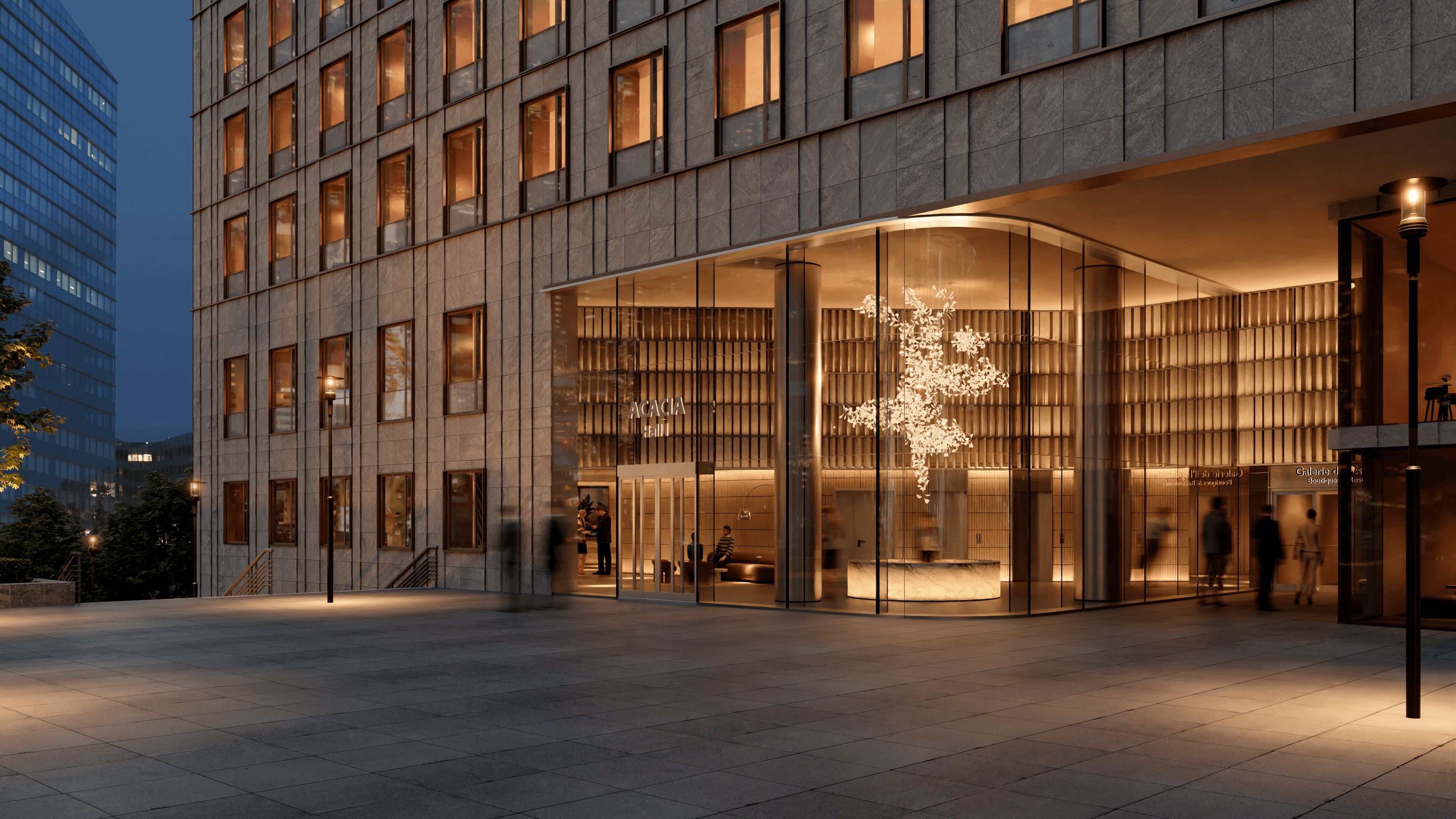
In 2022, we worked with an architecture team on an international competition for the renovation of an office building in Paris. The design team was awarded first place.
We developed a series of images that communicate the project's most powerful ideas through a soft colour palette, diverse spatial compositions and multiple points of view. Each image carried a specific part of the argument, and together they read as one coherent proposal.
Why it worked
Across the competitions we've taken part in, the same three things have made the difference for the design teams we work with:
01
Level of detail
Materials, light, furniture and context are built with the same care as the architecture. A jury doesn't have to imagine how the proposal will feel: every surface and every space is already resolved in the image.
02
Versatility to change
Competition designs keep evolving until the last days before submission. Working in full 3D lets us adapt views, materials and design decisions whenever the team needs to, without starting over and without losing quality.
03
Exactly how it will look
A complete 3D model, not a collage, shows how everything comes together: proportions, how the renovation meets the existing building, how light moves through the spaces. The jury sees the project as it will actually be built.
Beyond the competition
A winning entry is only the beginning of a project. The same visual language that convinces a jury can be carried into client presentations, approvals, press and, when the project is commercial or residential, its marketing and sales. Starting with the right images means the project never has to be explained from zero again.
Entering a competition? Let's make your ideas impossible to miss.
77 is a full-stack visualization and PropTech studio for real estate. We work alongside architecture teams to turn their strongest ideas into images a jury understands at first sight, and that keep working long after the result is announced.